
Timée: a resonance of antiquity
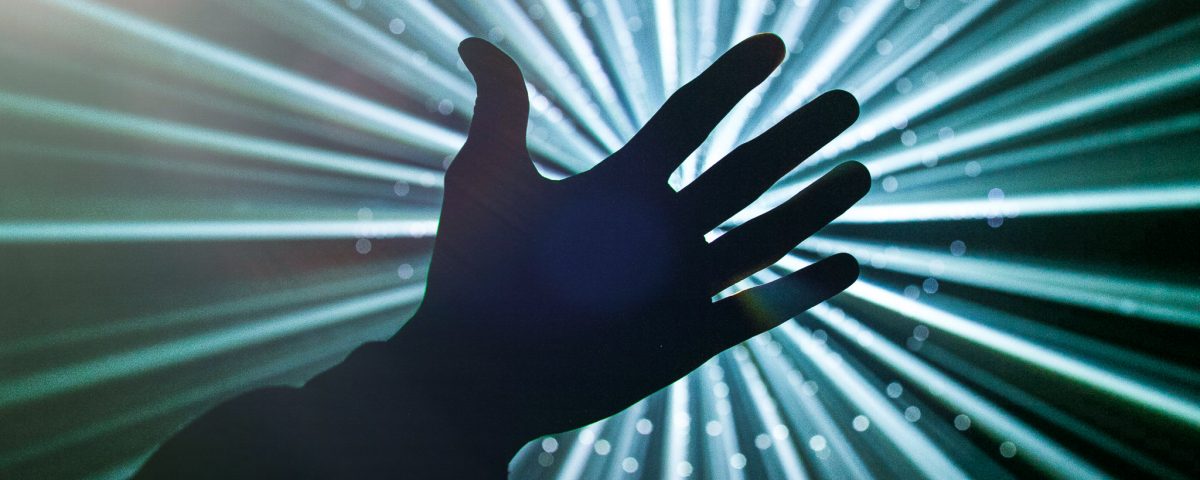
One of the exhibitions that were part of the 16th International Image Festival - ISEA2017, was Timée; an installation full of lights and sound presented by the French artist Guillaume Marmin, which invited reflection on the mixture of ancient philosophical theories and current technological practices.
- Good morning Guillaume, welcome to ISEA2017. Can you tell us a little about yourself and your career as an artist?
Hello, I am a French plastic artist. I am very happy to be in Manizales. Thanks to ISEA for inviting me this year. I come more from video, I made many experimental installations and videos and now my work is more oriented by light, and its relationship with sound and space, as I did with the Timée installation that we were able to see in Manizales.
- Regarding your work Timée, can you tell us about the creation process and why it is called Timée (apparently it comes from Plato's book)?
Yes. Well, it's hard to talk about the process before explaining what Timée is. The idea comes from Plato's book, Timée. And in this book, Plato explains a little about his conception of the cosmos. It is a very complex book because it is a mixture of Pythagorean science, philosophy, but also religion. So honestly it's complex to understand, but what's interesting is that, for him, the universe is like a perfect musical partition, and the distances between the planets are equivalent to musical harmonies because all of this was created by the gods, so for him there's like a music of the spheres that exist. That is why we confront and discuss this theory, which today seems very old, with astrophysicists, and we compare it with the knowledge of our days. And what was interesting was to see that in the end Timée still has resonance today. For example, scientists study the frequencies of the planets that are very low frequencies, that we cannot hear, but if we transpose them to 15 octaves, they enter the audible spectrum and we can hear them. And each planet has its own frequency, depending on its physical constitution, its mass. For example, the sun would emit a single sharp. So yes, we find a lot of repercussions like that, around this music of spheres that has actually crossed the ages and is still a little bit present today.
- And this work was built in collaboration with another artist?
I created the project with Philippe Gordiani, a French musician and composer, with whom I have been working for many years, in fact, there are 4 projects that we created together, always looking for a common language between sound and visual, that is, creating like an alphabet together, imagining that such a sound will be represented by such a shape or such a color and playing with it to create a common writing.
- Plato is an ancient philosopher and you use new technologies, how do you transpose this ancient world through technologies?
Yes, what interests me, in fact, is to play with knowledge that is ancient or very modern, and confront it with today's tools and see how it resonates. Not being only in the technique, even if it interests me a lot; face very different things that I can read or find somewhere, be it ancient metaphysics, Japanese philosophy as in another project, or neurosciences in a future project.
- The experience we live when we enter the box; the experience of the public, did you think about it to immerse them in the work or is it a process that you thought about afterwards?
Yes, the desire is to really immerse the public in the installation, for people to have the impression of being in another place for a few minutes, and the light materialized by the smoke, as well as the spatialized sound, are really complementary in this role. We realize that one does not go without the other and it is really the combination of the two, the common movement between light and sound, that I think gives this impression of immersion and, sometimes, this loss of reference, spatial references, but also temporary, in the dark, in music; people sometimes don't know how long they really stay inside, for me it's quite interesting too.
- In relation to your experience at the Festival and in Colombia, is this the first time you come to Latin America, to Colombia? What do you think of the country?
Well, I had already presented the installation in Mexico, at FIMA, and well, before coming to Manizales, we presented it in Bogotá, at the Universidad de Los Andes, and I must say that the reception was great, I have the impression that there are new teams that they are built, that are growing for the better today, that they welcome projects that need the technique, but also a lot of manpower, and there are a lot of people who are here to help this go well, yes.
- Do you have new projects for the future?
I do have future projects, performances and new installations, which will be released from September I think. For now, it is “top secret”.

 English
  Español