
Science and the landscape: creative unity in the work of Hicham Berrada
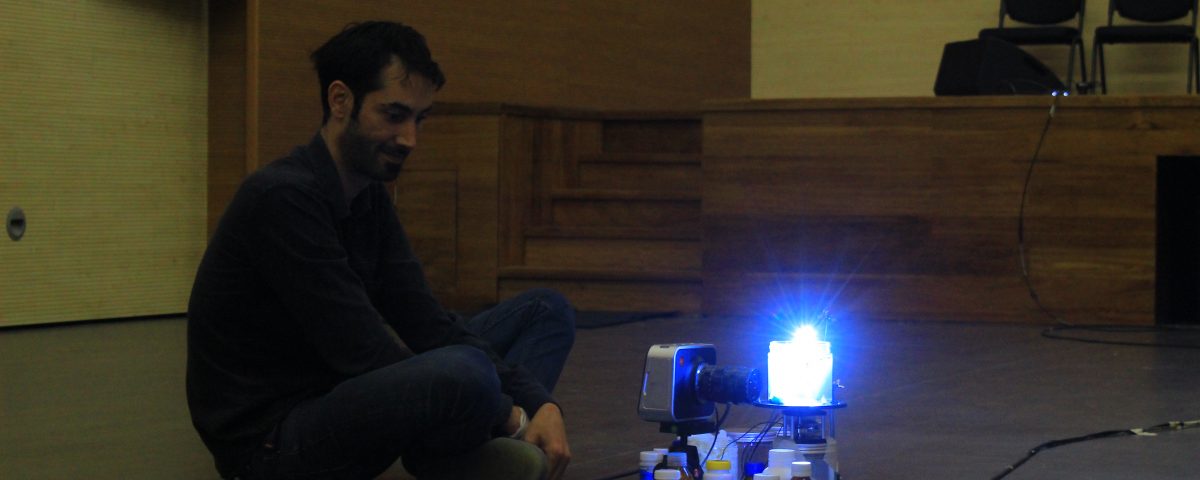
The French artist Hicham Berrada visited Manizales for the first time to present his artistic and scientific work within the framework of the 16th International Image Festival - ISEA2017. Elements such as time, nature or science are part of his artistic career and his interest in the future.
- Good morning Hicham and welcome to the Festival and ISEA.
Good morning and thanks.
- Tell us about your career as an artist.
I am a plastic artist. I work to a greater extent in installations, videos, performances and everything around the theme of landscape, because for me landscape is a rather ambiguous term that wants, above all, to say a man's point of view on nature, and I think that it is through the notion of landscape. It is because of the fact that the painters painted the landscape or that the photographers photographed the landscape, that our philosophical conception of nature is based on it (...). We often present a frozen nature, a fixed moment. And, on the contrary, I try to register within the history of art, to know what our parents did before us, to try to continue this history and, I try to be in a very classical relationship, I am always in a framework, of installation or video. I like the notion of frame, of composition. The only thing I try to bring is movement. For me, nature is never fixed, it is always in motion, with its temporalities, like a bronze or a building, which we could believe to be eternal. Everything has a lifetime. A photograph is guaranteed by Kodak for 400 years, after which it turns black. A bronze outdoors, we can expect to keep it for 15,000 years. Some contemporary works of art in resin, if we can keep them for more than 50 years, that's fine. So I really like working on time and nature in general.
- Is that what you do with Présage precisely?
Présage is that really. Synthesize that. It's been more or less 10 years since I developed this practice; it is simply an empty jar, filled with water, and I control the regularity, the mucus, the temperature, certain parameters. And it is, really, the idea of being as close as possible to the work of a painter, replacing the knowledge that a painter might have about the paint on the canvas, with knowledge of the physical, chemical world, and being able to act on this small jar as on a canvas, and then give birth to landscapes in movements that have a beginning, an end and that last only for a defined moment.
- So there is an artist side and a very chemical side too?
Well yes…
- Is it only in this work or in all?
It shows up a bit in all my work. In fact, I really like trying to act reality as if it were an image. In a small jar or sometimes in nature, in terrariums, in different contents. I use science as a tool, really as a hammer, a burin, it is a way of being able to act on reality, to modify its image and use the basic scientific protocol. It is so that today, science, in certain areas, has extremely complex and specialized things. Science, in principle, is observing nature or an object in the laboratory, changing a parameter, aiming, etc. And little by little, learn to know your subject of study. In fact, it's what I do in the workshop, try 10 degrees, 12 degrees, 14 degrees, until I have the necessary tools to better control the image that appears. In almost all my projects I collaborate with different people, most of them scientists, but also many of them are botanists, horticulturists, architects. I really like the collaborative model, like in the movies. I really think that if there is an art that marked the 20th and 21st centuries, it is cinema. Much more than contemporary art, sculpture or painting. It is something that was completely embedded in society, that created its own codes, that created a distribution, an economy. I really like the world of cinema. And I like in contemporary art to try to work on a small scale, a bit like that, not to work alone in my studio, but to try as much as possible to find people and work with them.
- And, for example, in the performance that you presented at the Festival, there was someone in charge of the music. Have you found it here?
Yes. In fact, to each of my performances, I invite a musician friend, I almost give him carte blanche. The only obligation is to have a fairly small device for the scenery. The fact of being alone, with a set of not very complex devices and I especially like this matter of the huge gap between a small jar and a small piano that produces, thanks to the technology of sound production and diffusion, something that can be approached to the opera. I really like this imbalance.
- Last question, about your trip to Colombia, is it the first time you come? What do you think of the country?
I've only been in Manizales for three days, I really like the city from a landscape point of view. It's amazing, I really like the fog, I really like the mountains, the fact that the whole city is wavy. For me, it's really wonderful from an aesthetic, plastic point of view. And the people too, very friendly. For me, there is a very good work spirit, way of being.

 English
  Español